Temporal Graph Learning · Fraud Detection
Temporal GNN for Blockchain Fraud Detection
A temporal-graph research build comparing TGAT-style structural reasoning with an optimized XGBoost baseline under a documented benchmark protocol.
Documented benchmark · modelling trade-offs clearly labelled
Temporal-graph modelling trade-off
TGAT improves predictive quality in the documented benchmark run while requiring greater latency and memory than XGBoost.
Scope
Role and problem
My role: Built and documented a temporal-graph modelling pipeline and comparative validation path. Public claims are limited to the published benchmark artifacts.
Fraud and anomalous interactions are relational and time-dependent. Flattened tabular features can be fast, but they may lose higher-order structural context as interactions evolve across a network.
Architecture
System flow
Temporal interaction stream
Rolling tabular features
XGBoost baseline
Continuous-time encoding
TGAT-style attention
Dynamic link prediction
Latency and memory trade-off analysis
Results and scope
Public record
98.42%
Wikipedia-profile TGAT AUC-ROC
Benchmark result from the comparative report.
94.20%
Enterprise-profile TGAT AUC-ROC
Benchmark result on the higher-complexity transaction profile.
31.5–78.9 ms
TGAT latency range
Per-batch inference latency across the documented benchmark profiles; XGBoost remains substantially faster.
Shared here: Shared here: benchmark charts for modelling trade-offs and pipeline behaviour.
Published artifacts
Selected artifacts.
Charts, screenshots, and media artifacts supporting this case study.
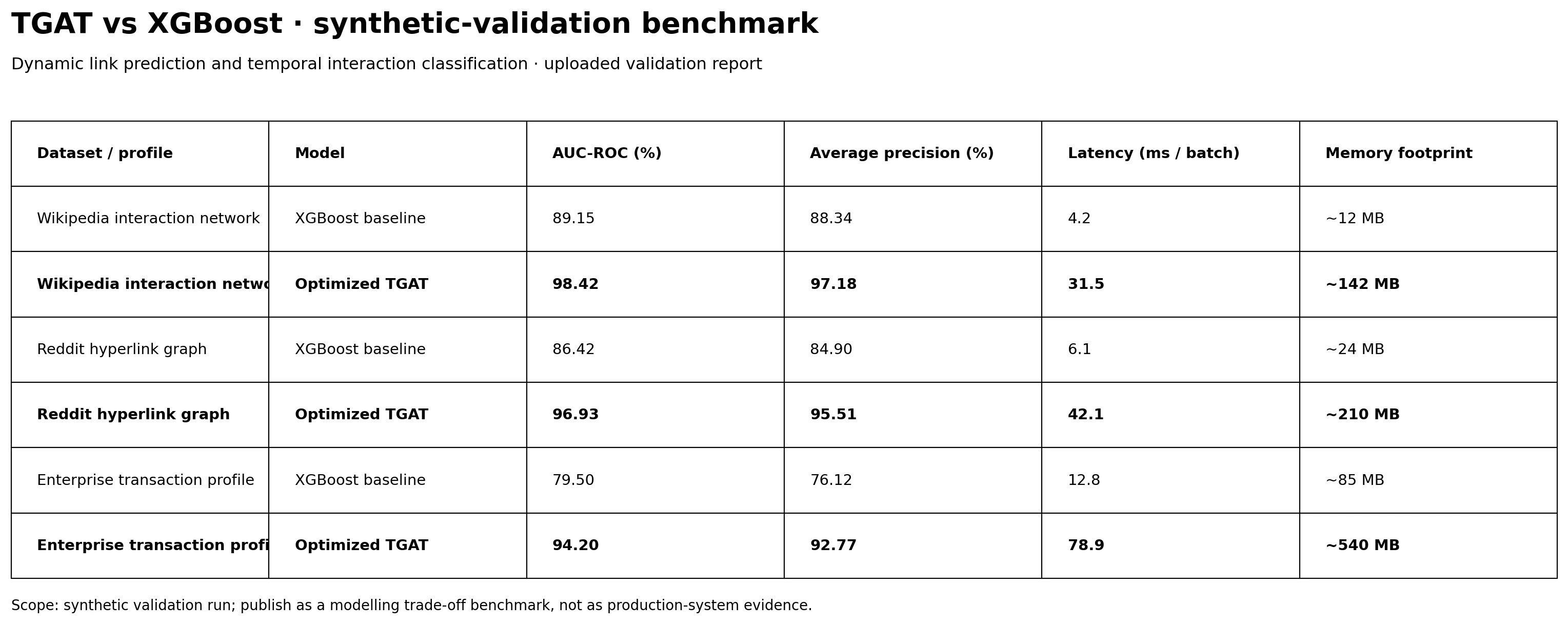
image artifact
TGAT versus XGBoost benchmark table
Documented benchmark across Wikipedia interaction, Reddit hyperlink, and enterprise-style transaction profiles.
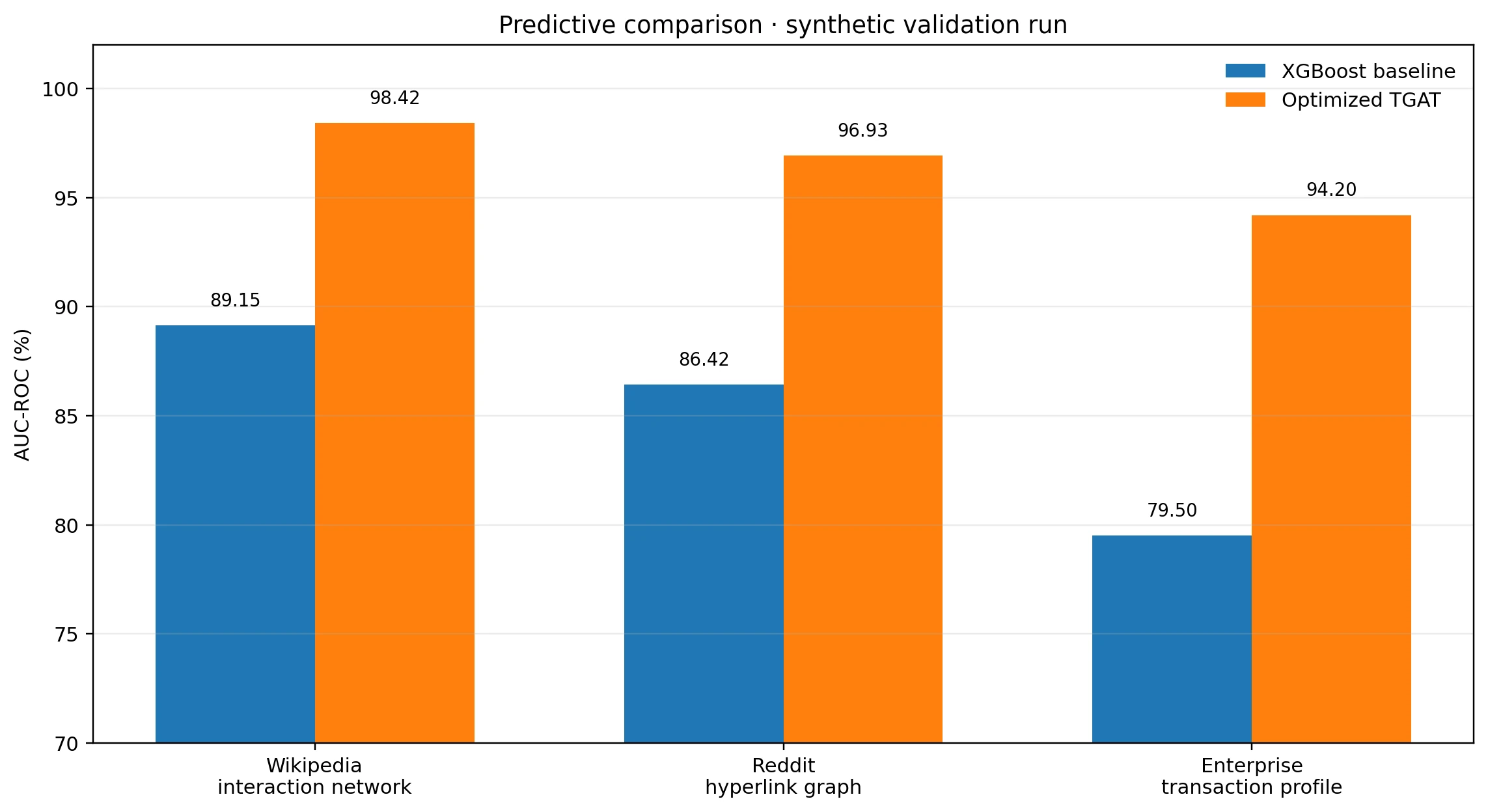
image artifact
TGAT and XGBoost AUC-ROC comparison
AUC-ROC comparison from the benchmark report.
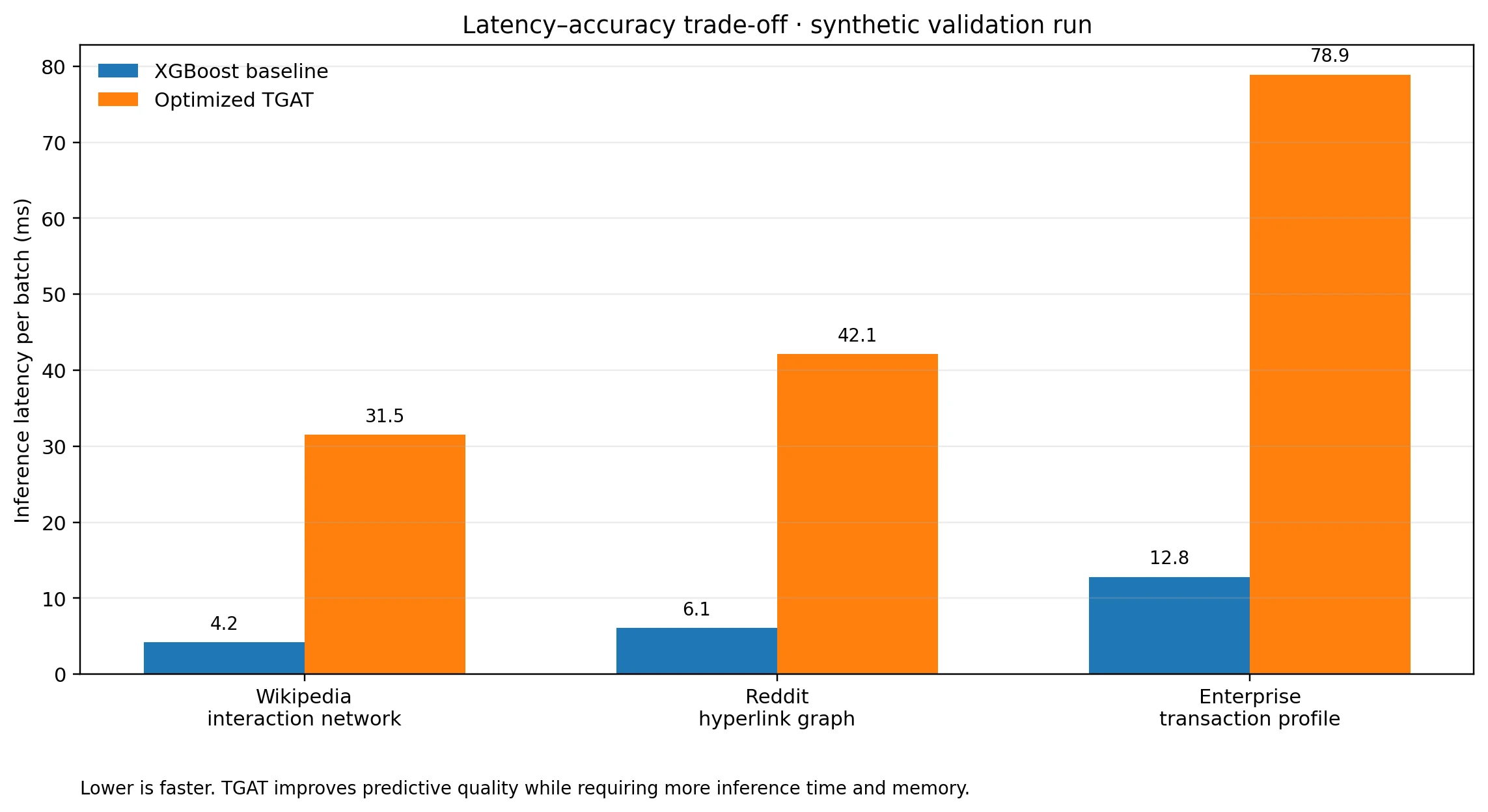
image artifact
Inference-latency trade-off
Per-batch latency comparison from the benchmark report. Lower is faster.
Contribution
- Modelled dynamic interactions as a temporal graph.
- Built a TGAT-style validation path with continuous-time encodings and attention-based message passing.
- Compared predictive quality, latency, and memory trade-offs against a tabular XGBoost baseline.
- Label the benchmark as a documented comparison, not a production deployment.
Lessons
- Model choice should follow the structure of the problem.
- Higher predictive quality can carry meaningful latency and memory costs.
- Benchmark evidence is useful only when its boundary is explicit and the protocol is documented.
Limitations
- The public benchmark is a documented comparison rather than a live production benchmark.
- The enterprise transaction profile is a representative validation scenario, not a disclosed client dataset.
- Deployment decisions still require dataset-specific reruns, calibration, and operational testing.
Stack
- PyTorch
- NetworkX
- TGAT
- Temporal GNNs
- XGBoost
- Fraud Detection
- Benchmarking